> ## Documentation Index
> Fetch the complete documentation index at: https://bytebeam.io/docs/llms.txt
> Use this file to discover all available pages before exploring further.
# Customising device shadow
> Learn about streams and device shadows in client applications with this document. Discover how default parameters like timestamp and sequence number are pushed to the device shadow stream. Explore the possibility of creating custom device shadow streams with additional fields.
Every project in Bytebeam comes with a default [Device Shadow](https://bytebeamio.mintlify.app/getting-started/device-shadow) stream. The stream by default contains just three fields `Status`, `timestamp`, and `sequence`.
This guide shows how to create additional fields and write data to this stream from your application.
For that, Click on the **username** at the top right corner of the Bytebeam cloud console and navigate to **Settings**
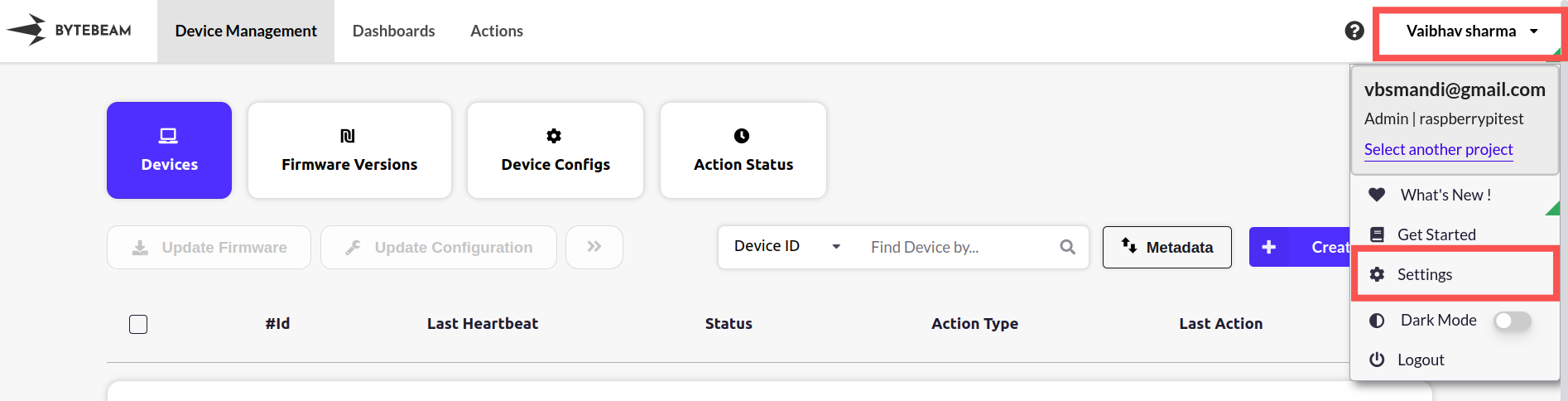 Here under the **Stream** Tab, you can find “**device\_shadow**”
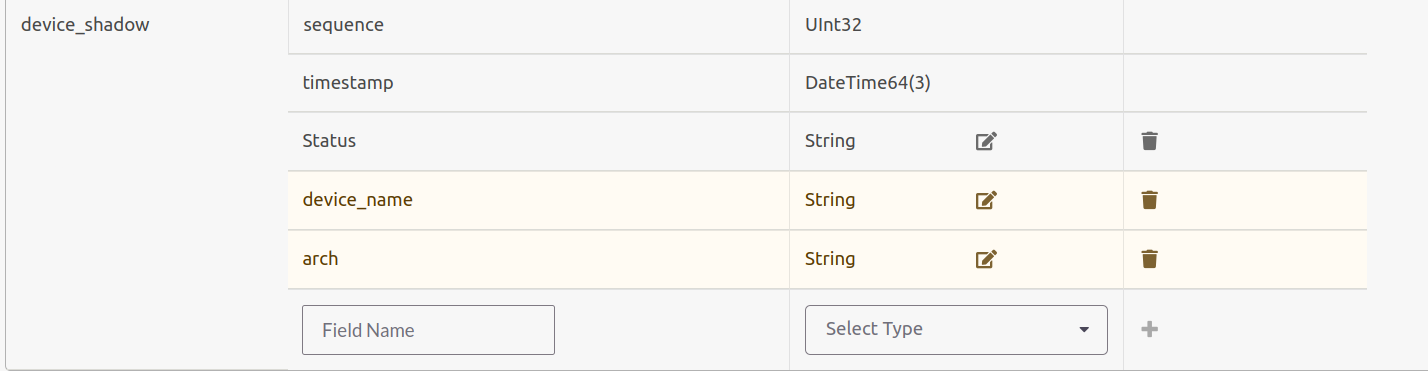
For example, add two new columns `device_name` and `arch` to the device shadow. You can do this by entering the field name and type and clicking the + button.
Here under the **Stream** Tab, you can find “**device\_shadow**”
For example, add two new columns `device_name` and `arch` to the device shadow. You can do this by entering the field name and type and clicking the + button.
 After adding both fields your device shadow will look like the below:
 Now update your application to push this data to the device.
:::codeblocktabs
```python theme={null}
import socket
import json
import time
s = socket.socket(socket.AF_INET, socket.SOCK_STREAM)
s.connect(("localhost", 5050))
# Constructs a payload and sends it over TCP to uplink
def send_data(s, payload):
send = json.dumps(payload) + "\n"
s.sendall(bytes(send, encoding="utf-8"))
# Add more parameters to device shadow
def send_device_shadow(s, sequence):
timestamp = int(time.time() * 1000)
payload = {
"stream": "device_shadow",
"sequence": sequence,
"timestamp": timestamp,
"device_name": "Beaglebone Black Rev. C",
"arch": "armv7",
}
print(payload)
send_data(s, payload)
print("Starting Uplink Bridge App")
sequence = 1
while True:
time.sleep(10)
send_device_shadow(s, sequence)
sequence += 1
```
```javascript theme={null}
const net = require("net");
// Connect to the server
const client = new net.Socket();
client.connect(5050, "localhost", () => {
console.log("Connected to server");
});
// Constructs a payload and sends it over TCP to uplink
function sendData(payload) {
const send = JSON.stringify(payload) + "\n";
client.write(send);
}
// Send device shadow data
function sendDeviceShadow(sequence) {
let timestamp = Date.now();
let payload = {
stream: "device_shadow",
sequence: sequence,
timestamp: timestamp,
device_name: "Beaglebone Black Rev. C",
arch: "armv7",
};
console.log(payload);
sendData(payload);
}
console.log("Starting Uplink Bridge App");
let sequence = 1;
setInterval(() => {
sendDeviceShadow(sequence);
sequence++;
}, 10000);
```
```rust theme={null}
use std::net::TcpStream;
use std::io::{Read, Write};
use std::thread;
use std::time::{Duration, SystemTime};
use serde_json::{Value, json};
async fn send_data(mut stream: &TcpStream, payload: serde_json::Value) {
let send = format!("{}\n", payload.to_string());
stream.write_all(send.as_bytes()).await.unwrap();
}
async fn send_device_shadow(mut stream: &TcpStream, sequence: u64) {
let timestamp = SystemTime::now()
.duration_since(SystemTime::UNIX_EPOCH)
.unwrap()
.as_millis();
let payload = json!({
"stream": "device_shadow",
"sequence": sequence,
"timestamp": timestamp,
"device_name": "Beaglebone Black Rev. C",
"arch": "armv7"
});
println!("{:?}", payload);
send_data(&mut stream, payload).await;
}
#[tokio::main]
async fn main() {
let addr = "localhost:5050";
let mut stream = TcpStream::connect(&addr).await.unwrap();
println!("Starting Uplink Bridge App");
let mut sequence = 1;
loop {
thread::sleep(Duration::from_secs(5));
send_device_shadow(&mut stream, sequence);
sequence += 1;
}
}
```
```go theme={null}
package main
import (
"encoding/json"
"fmt"
"net"
"os"
"strconv"
"time"
)
// DeviceShadow represents the payload structure
type DeviceShadow struct {
Stream string `json:"stream"`
Sequence int `json:"sequence"`
Timestamp int64 `json:"timestamp"`
DeviceName string `json:"device_name"`
Arch string `json:"arch"`
}
func sendData(conn net.Conn, payload interface{}) {
data, _ := json.Marshal(payload)
fmt.Println(string(data))
conn.Write(append(data, '\n'))
}
// sendDeviceShadow constructs and sends a device shadow payload
func sendDeviceShadow(conn net.Conn, sequence int) {
t := time.Now().UnixNano() / int64(time.Millisecond)
payload := DeviceShadow{
Stream: "device_shadow",
Sequence: sequence,
Timestamp: t,
DeviceName: "Beaglebone Black Rev. C",
Arch: "armv7",
}
fmt.Println(payload)
sendData(conn, payload)(conn, payload)
}
func main() {
conn, err := net.Dial("tcp", "localhost:5050")
if err != nil {
fmt.Println("Error connecting:", err.Error())
os.Exit(1)
}
defer conn.Close()
fmt.Println("Starting Uplink Bridge App")
sequence := 1
for {
time.Sleep(5 * time.Second)
sendDeviceShadow(conn, sequence)
sequence++
}
}
```
:::
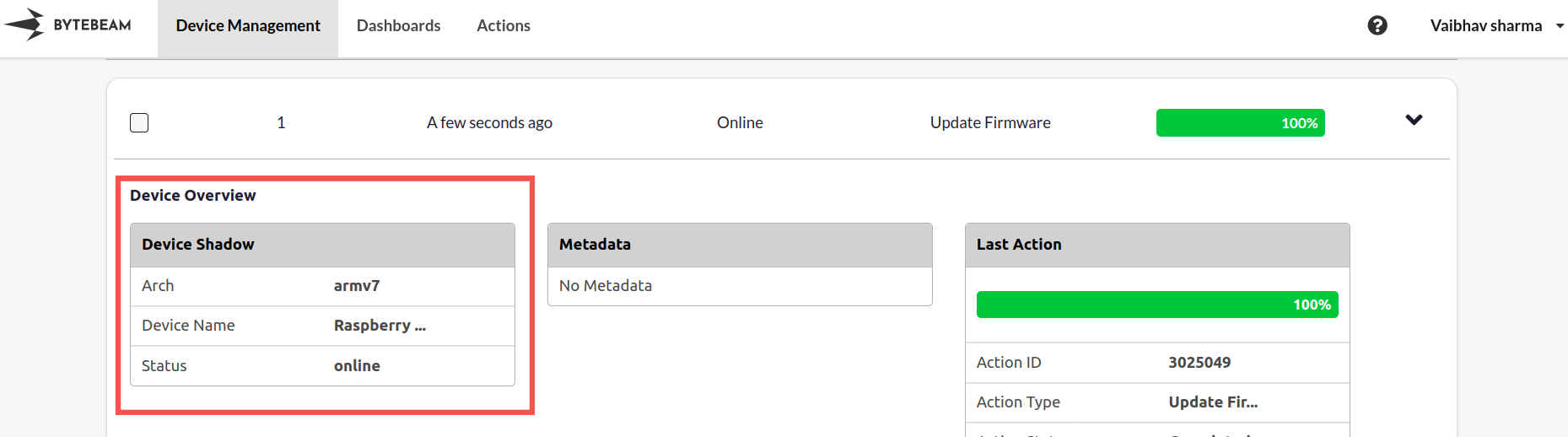
You should now be able to see the new fields on Bytebeam cloud:
Now update your application to push this data to the device.
:::codeblocktabs
```python theme={null}
import socket
import json
import time
s = socket.socket(socket.AF_INET, socket.SOCK_STREAM)
s.connect(("localhost", 5050))
# Constructs a payload and sends it over TCP to uplink
def send_data(s, payload):
send = json.dumps(payload) + "\n"
s.sendall(bytes(send, encoding="utf-8"))
# Add more parameters to device shadow
def send_device_shadow(s, sequence):
timestamp = int(time.time() * 1000)
payload = {
"stream": "device_shadow",
"sequence": sequence,
"timestamp": timestamp,
"device_name": "Beaglebone Black Rev. C",
"arch": "armv7",
}
print(payload)
send_data(s, payload)
print("Starting Uplink Bridge App")
sequence = 1
while True:
time.sleep(10)
send_device_shadow(s, sequence)
sequence += 1
```
```javascript theme={null}
const net = require("net");
// Connect to the server
const client = new net.Socket();
client.connect(5050, "localhost", () => {
console.log("Connected to server");
});
// Constructs a payload and sends it over TCP to uplink
function sendData(payload) {
const send = JSON.stringify(payload) + "\n";
client.write(send);
}
// Send device shadow data
function sendDeviceShadow(sequence) {
let timestamp = Date.now();
let payload = {
stream: "device_shadow",
sequence: sequence,
timestamp: timestamp,
device_name: "Beaglebone Black Rev. C",
arch: "armv7",
};
console.log(payload);
sendData(payload);
}
console.log("Starting Uplink Bridge App");
let sequence = 1;
setInterval(() => {
sendDeviceShadow(sequence);
sequence++;
}, 10000);
```
```rust theme={null}
use std::net::TcpStream;
use std::io::{Read, Write};
use std::thread;
use std::time::{Duration, SystemTime};
use serde_json::{Value, json};
async fn send_data(mut stream: &TcpStream, payload: serde_json::Value) {
let send = format!("{}\n", payload.to_string());
stream.write_all(send.as_bytes()).await.unwrap();
}
async fn send_device_shadow(mut stream: &TcpStream, sequence: u64) {
let timestamp = SystemTime::now()
.duration_since(SystemTime::UNIX_EPOCH)
.unwrap()
.as_millis();
let payload = json!({
"stream": "device_shadow",
"sequence": sequence,
"timestamp": timestamp,
"device_name": "Beaglebone Black Rev. C",
"arch": "armv7"
});
println!("{:?}", payload);
send_data(&mut stream, payload).await;
}
#[tokio::main]
async fn main() {
let addr = "localhost:5050";
let mut stream = TcpStream::connect(&addr).await.unwrap();
println!("Starting Uplink Bridge App");
let mut sequence = 1;
loop {
thread::sleep(Duration::from_secs(5));
send_device_shadow(&mut stream, sequence);
sequence += 1;
}
}
```
```go theme={null}
package main
import (
"encoding/json"
"fmt"
"net"
"os"
"strconv"
"time"
)
// DeviceShadow represents the payload structure
type DeviceShadow struct {
Stream string `json:"stream"`
Sequence int `json:"sequence"`
Timestamp int64 `json:"timestamp"`
DeviceName string `json:"device_name"`
Arch string `json:"arch"`
}
func sendData(conn net.Conn, payload interface{}) {
data, _ := json.Marshal(payload)
fmt.Println(string(data))
conn.Write(append(data, '\n'))
}
// sendDeviceShadow constructs and sends a device shadow payload
func sendDeviceShadow(conn net.Conn, sequence int) {
t := time.Now().UnixNano() / int64(time.Millisecond)
payload := DeviceShadow{
Stream: "device_shadow",
Sequence: sequence,
Timestamp: t,
DeviceName: "Beaglebone Black Rev. C",
Arch: "armv7",
}
fmt.Println(payload)
sendData(conn, payload)(conn, payload)
}
func main() {
conn, err := net.Dial("tcp", "localhost:5050")
if err != nil {
fmt.Println("Error connecting:", err.Error())
os.Exit(1)
}
defer conn.Close()
fmt.Println("Starting Uplink Bridge App")
sequence := 1
for {
time.Sleep(5 * time.Second)
sendDeviceShadow(conn, sequence)
sequence++
}
}
```
:::
You should now be able to see the new fields on Bytebeam cloud: